Benchmark
It answers in about a second and a half.
A small model reading a compiled, on-device memory — where feeding a much larger model your whole history takes tens of seconds, and sends it off your machine.
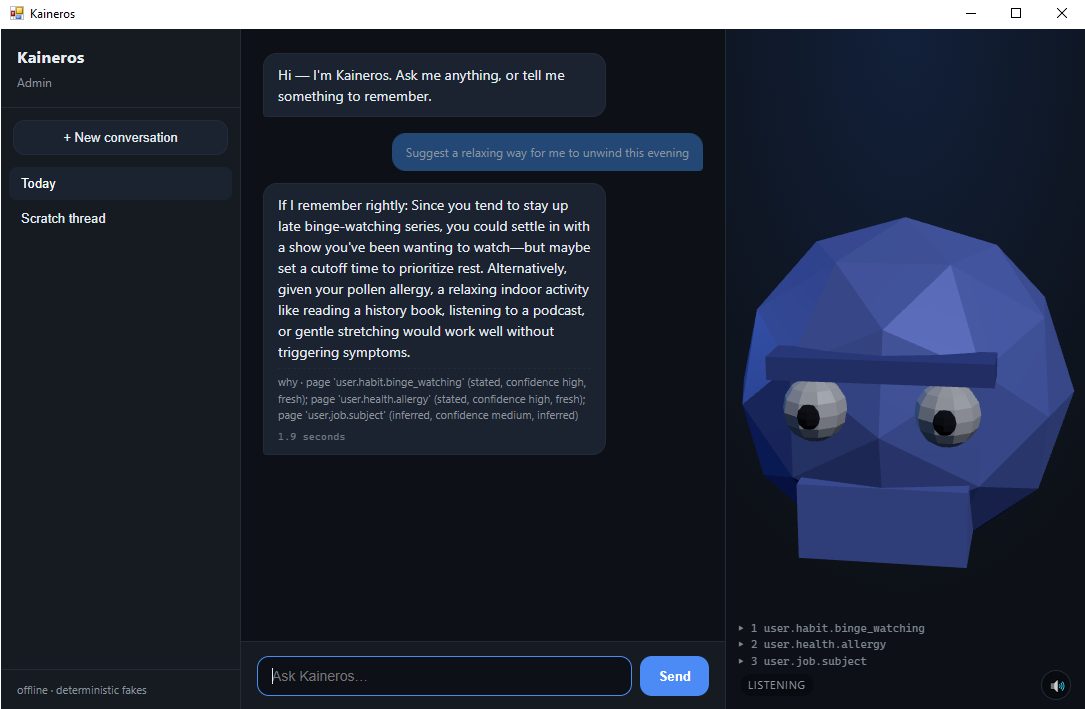
We measured Kaineros against PersonaMem, a benchmark for tracking a user across a long, evolving conversation, three ways — the same questions, scored the same way:
- Kaineros — a small model reading the compiled wiki, on your machine. The slow compile happens once, off the clock.
- The same small model, raw history — handed the full raw conversation instead of the wiki. Isolates what the wiki changes.
- A much larger model, raw history — reading the whole conversation. A ceiling reference.
| Setup | Reads | Accuracy | Response time |
|---|---|---|---|
| Kaineros | compiled wiki | 0.41 | ~1.4 s |
| Small model | raw history | 0.50 | ~28 s |
| Large model | raw history | 0.67 | ~28 s |
| Setup | Reads | Accuracy | Response time |
|---|---|---|---|
| Kaineros | compiled wiki | 0.61 | ~1.6 s |
| Small model | raw history | 0.73 | ~23 s |
| Large model | raw history | 0.78 | ~23 s |
Response time is time-to-first-word, measured. The raw-history rows must read tens of thousands of tokens before the first word; Kaineros reads a handful of compiled pages.
Reading it honestly
It trades a little accuracy for speed, cost, and privacy.
Reading the raw history is more accurate at this length — and Kaineros doesn’t beat it there. What the compiled memory buys is the thing an assistant actually needs to be usable:
- ~15× faster to the first word — about 1.5 seconds, not 25. A model re-reading your whole history isn’t an assistant; it’s a spinner.
- ~20× fewer tokens per answer, on a small model — cheap enough to run locally.
- Private. It reads a few pages from your own disk. Nothing pours your life into a context window.
And the gap is where the work now goes: teaching the fast search to reach the raw detail it needs, on demand, without giving up the speed.
Caveats
- Small samples (129 and 49 questions, 5 personas each) — a slice, not the full benchmark.
- Our own evaluation harness (PersonaMem’s data and format, our loader and scorer).
- Kaineros is a two-part system — a large model compiles offline, a small one answers — measured against single models reading raw context.
- One context length (32k). Every claim is checkable against the code.